
This article contains affiliate links. If you buy through them, Raqs Atlas may earn a small commission at no extra cost to you.
A belly dance costume can survive years of rehearsals, flights, quick changes and stage lights - and then decide to lose a hook five minutes before your entrance.
Anyone who performs regularly eventually learns the same lesson: costume maintenance is part of performance preparation. Beading is heavy. Stretch fabrics work hard. Rhinestones loosen. Hooks catch on other garments. Fringe tangles. A perfectly secure closure at home can behave very differently after a long journey, a humid dressing room and an energetic drum solo.
The good news is that most backstage costume problems are small. Better still, many can be solved with a kit that takes up less room than a pair of dance shoes.
This Raqs Atlas buyer’s guide focuses on useful, inexpensive items rather than glamorous purchases. The product examples below were refreshed through current AliExpress listings on 20 October 2026.
1. Start with a real sewing kit - not one lonely safety pin
A basic hand-sewing kit is still the most useful thing in a dancer’s emergency bag. Look for several needle sizes, black and neutral thread, small scissors, pins, a thimble and ideally a measuring tape.
A needle and thread can rescue a separating seam, reinforce a strap, reattach a hook or stop fringe from continuing to unravel. For costumes, add your own matching thread at home: a generic travel kit rarely contains the exact burgundy, turquoise or nude shade your wardrobe needs.
Current AliExpress example: Portable Travel Sewing Kit with needles, threads, scissors, pins and tape measure - $8.15 at Jianyi Flagship Store.
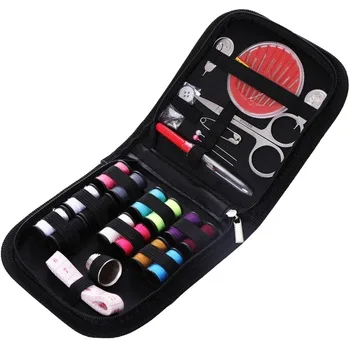
Pros: compact all-in-one format; includes the core tools needed for hand repairs; easy to keep permanently in a dance suitcase.
Cons: included thread colors may not match performance costumes; tiny kit scissors are useful for thread but should not be expected to handle substantial alterations.
Best for: every performer. If you buy only one item from this guide, make it a sewing kit.
2. Pack safety pins in more than one size
Safety pins are the emergency tool you hope not to use - but they are invaluable when there is no time to sew. A larger pin can temporarily secure an internal costume panel or waistband; smaller pins can control a lining, modesty panel or accessory.
Do not rely on safety pins as permanent structural repairs, especially on heavy beaded costumes. They can open, distort fabric and create uncomfortable pressure points while dancing. Think of them as a way to get safely through the next three minutes on stage, not the next three seasons.
A useful trick is to keep pins in a tiny rigid box rather than loose in a cosmetic pouch. Backstage floors are not where anyone wants to discover a missing pin barefoot.
3. A hot-fix applicator can save rhinestone-heavy costumes
If your wardrobe contains hot-fix rhinestones, a compact applicator can make maintenance much easier. These heated tools are designed to activate the adhesive on compatible hot-fix stones. They are especially useful at home before an event, when you notice small gaps in a crystal pattern.
Current AliExpress example: Hot Fix Rhinestone Applicator with 7 tips and glass rhinestones - $7.90 at QIAO Rhinestone & Crystal Jewelry World Official Store.

Pros: inexpensive entry point; multiple tips; useful for routine sparkle maintenance rather than replacing an entire embellishment section.
Cons: only appropriate for compatible hot-fix stones; it is a heated electrical tool, so it is not something to switch on hurriedly beside delicate chiffon five minutes before a show.
Best for: dancers with rhinestone-heavy costumes who already understand which stones and fabrics tolerate heat.
Always test on a hidden or spare piece first. Heat-sensitive mesh, plastics, glued trims and some synthetic fabrics can be damaged by excessive heat.
4. Carry spare crystals even if you do not carry the applicator
The most difficult part of replacing a missing stone is sometimes not the repair - it is finding a replacement that looks close enough.
Keep a small divided box containing leftover stones from costume alterations, matching beads, a few sequins and any unusual findings used on your most frequently worn costumes. When ordering a costume, it is worth asking the maker whether spare stones or beads can be included.
Current AliExpress example: Mixed-size glass hot-fix rhinestones, 720-2,000 pieces depending on variant - visible price from $5.02 at VC Rhinestone Store.

Pros: inexpensive source of emergency sparkle; mixed sets can cover minor losses across several costumes.
Cons: this is a mixed-quantity/variant listing - do not assume every option contains 2,000 stones. Colors and sizes also need to be checked carefully before purchase.
Best for: a general repair drawer. For a valuable professional costume, exact replacement stones from the original maker are preferable whenever possible.
5. Use the right adhesive - and know when not to glue
Not every fallen embellishment should be glued. Sew-on stones, appliqués and structural trims should usually remain sewn. But a suitable flexible fabric or rhinestone adhesive can be useful for flat-back stones that were originally glued.
The key word is suitable. Random household superglue can dry rigid, discolor fabric, cloud crystal backs and make later repairs miserable. Always follow the adhesive manufacturer’s instructions and test first.
Also remember drying time. A repair that feels secure after thirty seconds in the dressing room may not actually be cured. For last-minute emergencies, it can be safer to simplify the costume for one performance and repair it properly afterward.
6. Upgrade the way you transport the costume
A repair kit prevents disasters; good storage prevents some repairs from becoming necessary at all.
For embellished costumes, a garment bag with a gusset gives dimensional pieces more room than a completely flat cover. A transparent pocket is useful for labeling the costume or storing matching accessories without letting earrings and bracelets rub directly against beadwork.
Current AliExpress example: 40-inch Waterproof Hanging Garment Bag with Gusset and Clear Zipper Pocket - $9.39 at SUNNY DOLL Official Store.

Pros: gusseted design; hanging storage; separate visible pocket; useful for competitions and multi-costume events.
Cons: 40 inches will not suit every costume length; “waterproof” is the seller’s listing description, so do not treat it as permission to expose an expensive costume to rain or liquids.
Best for: dancers traveling to festivals, competitions and shows with one or more embellished costumes.
7. Build a tiny closure-and-hardware box
Hooks and eyes, bra extenders, clear elastic, small snaps and spare costume straps are not exciting purchases - until one breaks backstage.
Your personal kit should reflect your own wardrobe. If every costume uses the same style of large hook, carry that hook. If your skirts close with snaps, carry matching snaps. If a designer supplied extra fringe or trim, keep a small piece in the costume’s labeled repair pouch.
This is where personalization matters more than buying a huge generic kit. The ideal emergency box is essentially a miniature spare-parts department for the costumes you actually own.
What should stay at home?
Not every repair tool belongs backstage. Large glue guns, powerful heating tools, complicated electrical equipment and extensive alteration supplies are usually better kept at home or in a dedicated costume workshop.
A backstage kit should solve small, predictable problems safely. If a bra base is structurally failing, a zipper has separated completely or a heavily embellished panel is tearing away from the foundation, a rushed repair may create a wardrobe malfunction rather than prevent one.
The professional decision is sometimes to change costumes.
A practical packing system
Instead of throwing everything into one pouch, divide the kit into three layers.
Immediate emergency pouch: safety pins, needle, matching thread, small scissors, spare hooks, fashion tape if you use it, and the exact hardware your current costume needs.
Costume maintenance pouch: spare rhinestones, beads, appliqué pieces, appropriate adhesive and a hot-fix tool when relevant.
Travel protection: garment bag, accessory pouches, labels and soft barriers that stop jewelry from grinding against costume stones.
Before leaving for a show, inspect the costume under good light. Tug closures gently. Check straps. Look at the areas that receive the most movement: hip closures, bra straps, skirt hooks and the edges of heavily beaded panels. Ten minutes of inspection at home is much calmer than ten minutes of sewing backstage.
The real goal is not a perfect costume

Costume care can become surprisingly emotional. We invest money, time and identity in stagewear, and a missing stone can feel enormous when the audience is already entering the theatre.
Usually, it is not enormous.
Audiences see the whole performer: musicality, presence, expression, movement and connection. They are unlikely to count crystals from the fifth row. The purpose of an emergency kit is not to create perfection. It is to remove avoidable stress so that a small costume problem does not steal your attention from the performance itself.
Repair what matters. Secure what could become unsafe. Then dance.
Editorial record
- Author
- Raqs Atlas team
- Editor
- Milica Lestaric
- Published
- 1 October 2026
Editorially Reviewed — Checked by our editorial team against available sources.
Found an error? Request a correction — see our editorial policy.